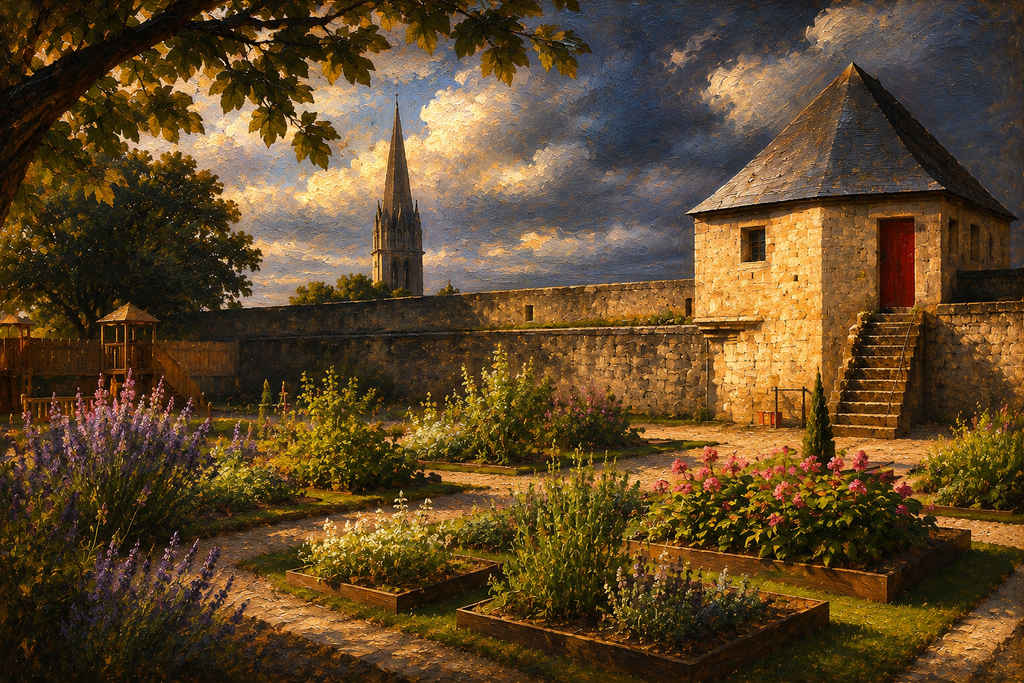
My interest in history extends beyond documenting events to how the past survives in landscapes, gardens, objects, myths, and cultural traditions. I am particularly interested in place as narrative: how environments preserve, organize, and transmit meaning across generations.
Central to my research is the concept of landscape as a living archive and historical palimpsest. Roads, rivers, forests, gardens, and architectural remnants preserve traces of successive generations, allowing multiple historical periods to coexist within a single place. Historical interpretation becomes an act of reading these traces, reconstructing narratives from material, ecological, and cultural evidence.
Gardens occupy a particularly important place in my research. I am interested in their functions as mnemonic devices, botanical archives, symbolic systems, and expressions of cultural identity, political authority, and philosophical thought. Plants themselves can preserve histories of migration, cultivation, ecological adaptation, and intergenerational knowledge.
My research also explores mythic ecology, sacred landscapes, landscape semiotics, and the relationship between environmental change and cultural memory. Drawing upon literature, mythology, historical geography, landscape archaeology, and the environmental humanities, I examine how environments participate in storytelling rather than merely providing their setting.
These interests inform my ongoing research into the historical landscapes of northern France, particularly the Seven Valleys and surrounding region, where firsthand exploration has deepened my understanding of the relationships among geography, historical experience, material culture, and remembrance.
Underlying these inquiries is a central question: What kinds of knowledge, memory, and narrative can only be preserved through place rather than text?
Selected Academic Work
Setting, Symbolism, and Myth in the Poetry of W.B. Yeats
Northeastern University | ENG3440 | Undergraduate Research
Irish landscapes, mythology, folklore, and heroic traditions become instruments of cultural and ecological reclamation in the poetry of W. B. Yeats. Drawing on Edward Said’s Culture and Imperialism, the paper examines how Yeats uses geographical settings, natural imagery, and mythological narratives to resist English imperialism.
The study also considers arboreal symbolism, mysticism, and the relationship between physical landscapes and cultural identity. Through poems such as “The Lake Isle of Innisfree,” “The Stolen Child,” “Leda and the Swan,” and the Cuchulain poems, Yeats’s work emerges as a means of reclaiming Irish history, traditions, and belonging through poetic imagination. Yeats, The Romantic versus The Realist: A Comparison
Northeastern University | ENG2331 | Professor Charles Archer | July 15, 2017
This paper examines the relationship between Romanticism and Realism in the poetry of W. B. Yeats through a comparative analysis of “The Stolen Child,” “Easter, 1916,” and “Sailing to Byzantium.” The analysis focuses on Irish mythology and folklore, historical and political upheaval, and the use of natural and symbolic landscapes to explore identity, mortality, and transcendence.
The analysis considers the interplay between mythological imagination and historical reality, revealing the complexity of Yeats’s poetic relationship with place, history, and cultural identity.
Journal #2: Comparative Journalism and Historical Analysis
Northeastern University | History | March–April 2021
A series of comparative analyses of American and international news coverage addressing immigration, volcanic activity in Iceland, labor organization, international corporate taxation, and the withdrawal of American troops from Afghanistan.
The journal examines differences in journalistic framing, rhetoric, source selection, and cultural perspectives. It also incorporates family oral histories of the Mexican Revolution and migration, connecting contemporary events with intergenerational memory, displacement, and belonging.
Independent Creative Nonfiction
Sol’s L.A.
Independent Creative Nonfiction | April 12, 2006
Written upon returning to Los Angeles after several months in San Diego, this personal essay examines the relationship between place, cultural identity, belonging, and creative expression. Through descriptions of neighborhood street vendors, open-air markets, culinary traditions, and the hillsides of Silver Lake, Los Angeles emerges as both home and muse.
The essay also serves as an unintended historical record of the city’s cultural landscape in 2006, preserving observations of everyday life, local traditions, and neighborhood commerce before subsequent changes brought about by gentrification.
Written years before my formal academic studies, Sol’s L.A. reflects an early fascination with place as narrative, sensory memory, and the relationship between landscape and identity—interests that continue to inform my research today.