
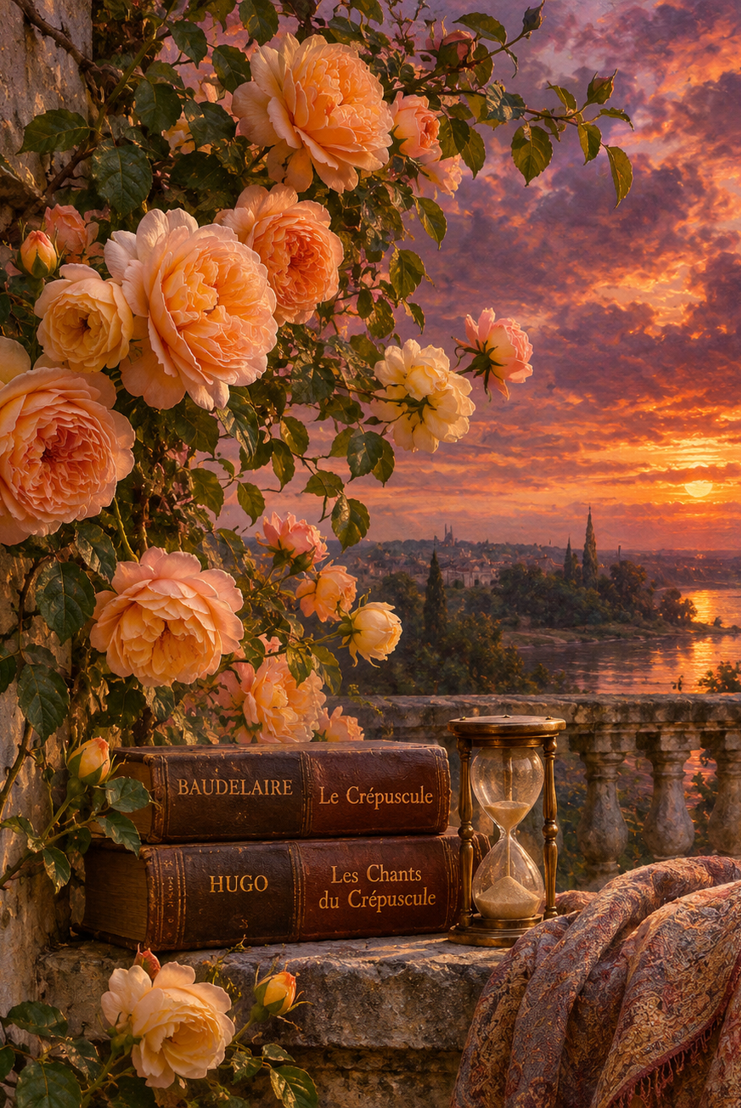
Rose Portrait
History & Heritage
Introduced in France in 1904 by Francis Dubreuil, ‘Crépuscule’ is a historic Noisette rose distinguished by its warm apricot blossoms, graceful climbing habit, and extended flowering season. Its name translates as “twilight,” beautifully capturing the shifting shades of gold, peach, and amber found in its flowers.
The Noisette Rose Heritage
Although closely associated with French horticulture, Noisette roses originated in Charleston, South Carolina, during the early nineteenth century.
Their history began with John Champneys, an American planter who crossed a musk rose (Rosa moschata) with a China rose, traditionally identified as ‘Old Blush.’ The resulting rose became known as ‘Champneys’ Pink Cluster.’
Philippe Noisette, a French horticulturist living in Charleston, subsequently raised seedlings from this rose and sent material to his brother Louis Noisette, a nurseryman in Paris. Introducing these roses to France marked the beginning of an important new class of garden roses.
Later crosses with Tea roses produced vigorous climbers with warmer colors, including shades of cream, yellow, copper, and apricot. ‘Crépuscule’ belongs to this later tradition, often called the Tea-Noisettes.
Francis Dubreuil and the Rose-Breeding Tradition of Lyon
Francis Dubreuil (1842–1916) was originally a tailor before entering the rose-growing profession through his marriage into the family of Lyonnais rose breeder Joseph Rambaux.
Following Rambaux’s death in 1878, Dubreuil helped continue and expand the family nursery, developing roses that combined beauty, fragrance, vigor, and abundant flowering.
His work also established an important link in the history of the Meilland rose-breeding dynasty. In 1909, his daughter Claudia married Antoine Meilland, who had worked in Dubreuil’s nursery. Their son, Francis Meilland, would later introduce the internationally renowned ‘Peace’ rose.
Thus, ‘Crépuscule’ occupies a distinctive place in the history of one of France’s most celebrated rose-growing families.
One of the Last Historic Noisettes
Introduced as Hybrid Tea roses increasingly dominated the commercial rose market, ‘Crépuscule’ was among the last Noisette varieties to be commercially introduced.
Although its precise parentage remains unknown, its supple, arching branches, fragrant flower clusters, and generous repeat flowering reflect its Tea-Noisette heritage.
Its flowers open in rich apricot and copper tones before gradually softening to pale peach and buff gold. Its cascading growth makes it particularly beautiful when trained over stone walls, arches, pergolas, and garden entrances.
According to the Meilland family’s historical account, ‘Crépuscule’ continues to grow in more than seventy-five rose gardens worldwide, spanning Europe, Australia, Japan, Canada, and the United States.
More than a century after its introduction, ‘Crépuscule’ remains a living testament to the golden age of French rose breeding. Its name captures one of nature’s most beautiful transformations: the gradual passage of daylight into evening, when the landscape is briefly illuminated in shades of amber, copper, and rose.
Literary & Cultural Influences
Charles Baudelaire: The Two Faces of Twilight
Few poets explored the mysteries of twilight as profoundly as Charles Baudelaire (1821–1867). In Les Fleurs du mal(1857), two poems address the transitional hours of the day: Le Crépuscule du soir (Evening Twilight) and Le Crépuscule du matin (Morning Twilight).
For Baudelaire, twilight is not merely a beautiful atmospheric phenomenon. It marks a transformation in the city’s character, when the familiar world becomes mysterious, and its hidden inhabitants emerge.
Le Crépuscule du soir opens with the lines:
Voici le soir charmant, ami du criminel;
Il vient comme un complice, à pas de loup;
Here comes the charming evening, friend of the criminal; It approaches like an accomplice, with a wolf’s tread.
Evening becomes both seductive and unsettling, offering rest to some while awakening the darker aspects of Parisian life.
The association with Les Fleurs du mal — literally “The Flowers of Evil” — lends an intriguing literary dimension to the rose ‘Crépuscule,’ contrasting its luminous beauty with Baudelaire’s darker interpretation of twilight.
Victor Hugo: Les Chants du crépuscule
Published in 1835, Victor Hugo’s Les Chants du crépuscule (Songs of Twilight) belongs to the great flowering of French Romanticism.
For Hugo, twilight becomes a metaphor for uncertainty, political transformation, spiritual questioning, and the passage between historical epochs. Written during the turbulent years following the July Revolution of 1830, the collection reflects a society suspended between an inherited past and an uncertain future.
Where Baudelaire discovers the mysteries of the nocturnal city, Hugo finds in twilight a language for the uncertainties of human existence.
Both writers demonstrate the extraordinary richness of the French word crépuscule, which can signify not only the fading of daylight but also the ending of an era.
Paul Verlaine: Soleils couchants
Another particularly fitting literary association is Paul Verlaine’s Soleils couchants (Setting Suns), published in Poèmes saturniens in 1866.
Une aube affaiblie
Verse par les champs
La mélancolie
Des soleils couchants.
A weakened dawn pours across the fields. The melancholy of setting suns.
Verlaine transforms the fading light into an emotional landscape, where color, memory, and melancholy become inseparable. His musical language and atmospheric imagery anticipate the French Symbolist movement.
The soft apricot and golden tones of ‘Crépuscule’ seem particularly suited to the delicate, dreamlike atmosphere of Verlaine’s poetry.
J. M. W. Turner: The Poetry of Light
The English Romantic painter Joseph Mallord William Turner (1775–1851) devoted much of his artistic life to capturing the extraordinary effects of light upon the natural world.
His sunsets, with their incandescent skies and dissolving landscapes, transformed atmospheric phenomena into expressions of the sublime.
Works such as The Fighting Temeraire (1839) and The Scarlet Sunset (c. 1830–1840) demonstrate his remarkable ability to render the fleeting intensity of evening light.
In The Fighting Temeraire, the setting sun also becomes a metaphor for the passing of an age, echoing twilight’s symbolism in Hugo’s poetry.
The copper, amber, and golden hues of ‘Crépuscule’ recall Turner’s extraordinary palette, particularly the luminous skies that distinguish his later paintings.
Claude Monet: The Fleeting Nature of Light
Claude Monet (1840–1926) approached light through a different artistic sensibility. Rather than emphasizing the Romantic sublime, Monet explored how familiar landscapes change under different atmospheric conditions.
His San Giorgio Maggiore at Dusk (1908–1912), with its brilliant orange, violet, and golden reflections across the Venetian lagoon, captures twilight’s fleeting splendor.
His series of paintings of the Houses of Parliament in London similarly explores how mist, sunlight, and atmospheric color transform architecture.
Like Monet’s landscapes, the flowers of ‘Crépuscule’ are never quite the same from one moment to the next. Their colors change as the blossoms mature and as daylight shifts across their petals.
Twilight and the French Garden
There is something particularly enchanting about a garden at twilight. As daylight fades, pale flowers become more luminous, fragrances linger in the evening air, and familiar pathways take on an almost dreamlike quality.
‘Crépuscule’ is a rose that seems to belong to that brief interval between daylight and darkness, when the ordinary landscape becomes something extraordinary.
The English translations of the French poetry above are my own, and for any mistakes, I apologize. These literary and artistic associations are thematic and what the rose reminded me of; no established evidence shows that Dubreuil named the rose after any particular poem or painting.
References
- Meilland International — Crépuscule (1904), Francis Dubreuil
- Meilland Richardier — The Family’s Horticultural Heritage Since 1867
- Heritage Roses Group — “A Honey of a Rose,” Elaine Sedlack, May 2021
- Roses ABC — Crépuscule
- Rogue Valley Roses — Crépuscule
- Baudelaire, Charles. Les Fleurs du mal (1857). Le Crépuscule du soir.
- Baudelaire, Charles. Les Fleurs du mal. Le Crépuscule du matin.
- Hugo, Victor. Les Chants du crépuscule (1835).
- Verlaine, Paul. Poèmes saturniens (1866), particularly Soleils couchants.
- The National Gallery — J. M. W. Turner, The Fighting Temeraire
- Tate — Joseph Mallord William Turner
- National Museum Cardiff — Art Collections
- Musée d’Orsay — Collections
Personal Impressions
I love a dramatic rose, and this one, with its history, its color, and its name, all convey drama to me. A Turner fan and someone with quite an obsession with the Year Without a Summer (Tambora volcanic eruption), which turned the skies into the dramatic oranges and yellows Turner captured with his brush, I found that this rose reminded me of those amazing skies in his paintings.
Botanical Profile
| Characteristic | Description |
|---|---|
| Botanical Name | Rosa ‘Crépuscule’ |
| Classification | Tea-Noisette, Old Garden Rose |
| Origin | France, Francis Dubreuil, 1904 |
| Bloom Color | Rich apricot and copper, fading to soft peach, buff, and pale gold |
| Fragrance | Strong, sweet fragrance |
| Flowering Season | Repeat flowering from late spring through autumn |
| Foliage | Glossy green leaves with reddish-purple new growth |
| Growth Habit | Vigorous climber with flexible, arching canes, reaching 6–12 feet |