
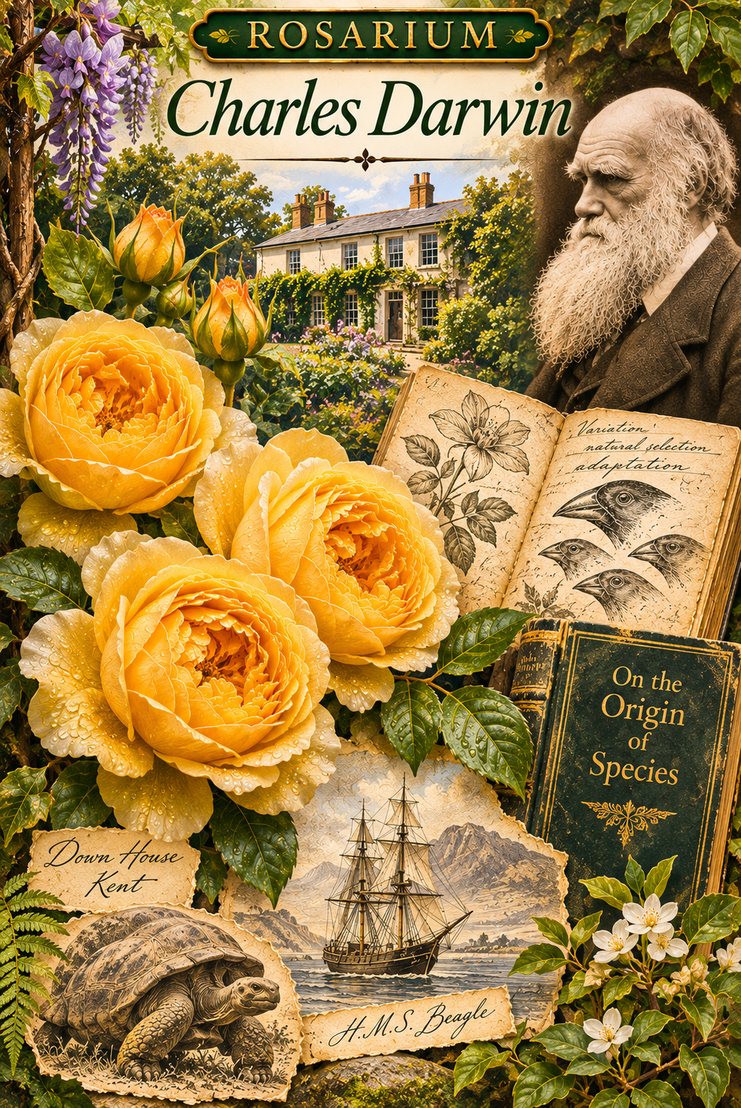
Rose Portrait
History & Heritage
Introduced by David Austin in 2003, ‘Charles Darwin’ (AUSpeet) belongs to the English shrub roses, a group developed to combine the romantic flower forms and fragrances of old garden roses with the repeat-flowering qualities of modern varieties.
Its large, deeply cupped flowers are distinguished by their unusual mustard-yellow coloring, which can soften to shades of lemon and sandy gold. Its rich fragrance ranges from soft floral tea to pure lemon, depending on growing conditions.
The rose was named in honor of Charles Darwin (1809–1882), the English naturalist whose work fundamentally changed our understanding of the living world. It is a particularly fitting tribute from a rose breeder, given Darwin’s extensive studies of variation, inheritance, and selective breeding.
The rose also has a geographical connection to its namesake. Darwin was born in Shrewsbury, Shropshire, not far from David Austin’s rose nursery in Albrighton. The name therefore celebrates both a distinguished figure in scientific history and the breeder’s regional heritage.
Developed from a cross between two unnamed seedlings, ‘Charles Darwin’ was bred for abundant flowering, fragrance, and the characteristic beauty of the English rose. It received a bronze medal at the Gifu Rose Trials in Japan in 2006.
Something feels particularly appropriate about a cultivated rose bearing Darwin’s name. Every modern garden rose owes its existence to generations of careful selection, experimentation, and propagation — the very processes of variation and artificial selection that Darwin examined in his scientific writings.
References
Literary & Cultural Influences
Charles Darwin and the Victorian Naturalist
Few figures have transformed humanity’s understanding of the natural world as profoundly as Charles Darwin (1809–1882). His curiosity, meticulous observations, and patience reflect many of the qualities gardeners cultivate.
Darwin’s work extended well beyond the study of animals and evolution. He was fascinated by plants and investigated their movements, reproductive strategies, adaptations, and relationships with insects. His garden and greenhouse at Down House in Kent became living laboratories where he conducted botanical experiments.
On the Origin of Species (1859)
Darwin’s landmark work, On the Origin of Species, introduced his theory of evolution by natural selection and challenged prevailing nineteenth-century ideas about the origins and diversity of life.
Of particular relevance to the Rosarium is the book’s opening chapter, “Variation under Domestication,” in which Darwin examines how human selection shapes the characteristics of cultivated plants and domesticated animals.
The extraordinary diversity of garden roses illustrates this principle beautifully. Through generations of deliberate selection, rose breeders have developed new colors, fragrances, flower forms, and flowering habits. David Austin’s English roses are a particularly striking example of this continuing horticultural tradition.
The Voyage of the Beagle (1839)
Darwin’s account of his five-year voyage aboard HMS Beagle is both a scientific record and a remarkable work of travel literature. His encounters with unfamiliar landscapes, plants, animals, and geological formations helped shape his later scientific theories.
The ship, finches, and Galápagos tortoise depicted in the Rosarium collage recall this extraordinary journey and the Victorian tradition of scientific exploration.
Darwin the Botanist
Darwin’s contributions to botany are sometimes overshadowed by his broader evolutionary theories. His botanical publications include On the Movements and Habits of Climbing Plants (1865), The Effects of Cross and Self Fertilisation in the Vegetable Kingdom (1876), and The Power of Movement in Plants (1880).
His research into orchid pollination was particularly remarkable. After examining the exceptionally long nectar spur of a Madagascan orchid, Darwin predicted the existence of a moth with a sufficiently long proboscis to pollinate it. The subsequent discovery of such a moth demonstrated the remarkable relationship between plants and their pollinators.
The Garden at Down House
Darwin lived at Down House from 1842 until his death in 1882. Its walled kitchen garden, greenhouse, experimental beds, and woodland paths provided both intellectual inspiration and personal sanctuary.
His beloved Sandwalk, known as his “thinking path,” was a place where walking and contemplation became part of his scientific routine.
Today, English Heritage preserves the gardens, offering a glimpse into the intimate relationship between Darwin’s domestic life, his love of nature, and his scientific discoveries.
The ‘Charles Darwin’ rose celebrates this enduring connection between the garden, the library, and the pursuit of knowledge.
References
- Primary literary works
- Darwin, Charles. (1839). The Voyage of the Beagle.
- Darwin, Charles. (1859). On the Origin of Species.
- Darwin, Charles. (1862). On the Various Contrivances by Which British and Foreign Orchids Are Fertilised by Insects.
- Darwin, Charles. (1865). On the Movements and Habits of Climbing Plants.
- Darwin, Charles. (1868). The Variation of Animals and Plants Under Domestication.
- Darwin, Charles. (1880). The Power of Movement in Plants.
- Historical and cultural resources
- Darwin Online — Complete Publications
- English Heritage — Darwin’s Living Laboratory
- English Heritage — History of Down House
- English Heritage — Down House Garden Highlights
- Christ’s College, Cambridge — Darwin Bibliography
- Darwin Correspondence Project — Variation Under Domestication
Botanical Profile
| Characteristic | Description |
|---|---|
| Botanical Name | Rosa ‘Charles Darwin’ (AUSpeet) |
| Classification | English Shrub Rose |
| Origin | England, David Austin, 2003 |
| Bloom Color | Rich mustard yellow, fading to lemon and sandy gold |
| Fragrance | Strong, varying between floral tea and pure lemon |
| Flowering Season | Repeat flowering from early summer through autumn |
| Foliage | Medium green |
| Growth Habit | Vigorous, broad, bushy shrub with upright growth |