
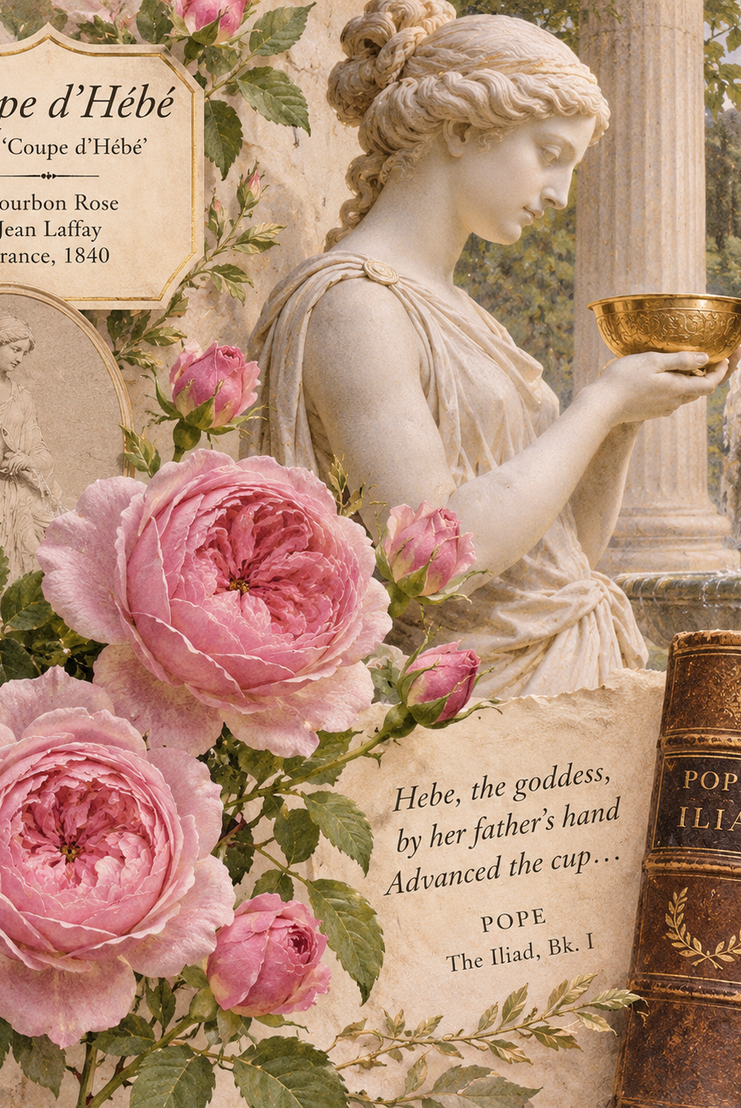
Rose Portrait
History & Heritage
Introduced in France in 1840 by rose breeder Jean Laffay, ‘Coupe d’Hébé’ is a historic Bourbon rose celebrated for its beautifully cupped pink flowers, rich fragrance, and graceful growth. Its name translates as “Hebe’s Cup,” referencing the Greek goddess of youth and cupbearer to the gods of Mount Olympus.
Bourbon roses originated on the Île Bourbon, now known as Réunion, in the Indian Ocean. They are traditionally believed to have arisen from a natural cross between a China rose and an autumn Damask rose. Their introduction to France in the early nineteenth century marked an important development in European rose breeding, combining the fragrance and flower forms of old European roses with the repeat-flowering potential of China roses.
Jean Laffay was a notable French rose breeder of the nineteenth century. His work helped develop several important classes of garden roses, particularly the Hybrid Perpetuals.
Despite its Bourbon heritage, ‘Coupe d’Hébé’ is principally a once-flowering rose, producing a magnificent display in late spring or early summer. Its densely petalled, silvery-pink flowers possess the characteristic beauty of the old garden roses that flourished before the introduction of the Hybrid Tea.
Its name also reflects classical mythology’s enduring influence on European horticulture. During the late eighteenth and early nineteenth centuries, Greek and Roman mythology permeated literature, sculpture, architecture, and garden design. Naming a rose after Hebe, the embodiment of eternal youth, seems particularly fitting for a flower whose beauty has endured for nearly two centuries.
A Rose Celebrated by Victorian Rosarians
Nineteenth-century horticulturists particularly admired ‘Coupe d’Hébé’. The English rosarian Thomas Rivers described it as “the gem of this family,” praising its wax-like pink coloring and the extraordinary regularity of its petals.
William Paul illustrated the rose in the first edition of his influential work, The Rose Garden (1848), and described it as “the ideal rose” in The Gardeners’ Chronicle in 1856.
At the first great National Rose Show in England in July 1858, ‘Coupe d’Hébé’ appeared in ten winning collections, showing its popularity among Victorian rose growers.
Its reputation extended well beyond Europe. The Camden Park nursery catalog in Australia documented it as early as 1850 under the translated name “Hebe’s Cup.” Rosa ‘Coupe d’Hébé’
Although generally classified today as a Bourbon rose, Victorian rosarians more specifically identified it as a Hybrid Bourbon. Historical accounts describe it as summer-flowering, although some modern growers report occasional later blooms. Rosa ‘Coupe d’Hébé’+2
The survival of ‘Coupe d’Hébé’ in contemporary heritage rose collections preserves not only the horticultural achievements of nineteenth-century France but also the artistic sensibilities of an age in which classical mythology, literature, and garden culture were closely intertwined.
References:
- Hortus Camdenensis — Rosa ‘Coupe d’Hébé’: Horticultural and Botanical History
- David Austin Roses — Coupe d’Hébé
- Friends of Vintage Roses — Hybrid Bourbon Catalogue
- Roses ABC — Coupe de Hebe
- Roses ABC — Jean Laffay
Literary & Cultural Influences
Hebe: The Goddess of Eternal Youth
In Greek mythology, Hebe was the daughter of Zeus and Hera and the personification of youth. As cupbearer to the Olympian gods, she served nectar and ambrosia, the divine sustenance associated with immortality. She later became Heracles’ wife after his elevation to Olympus.
Her name derives from the Greek hēbē, meaning youth or the prime of life. Traditionally depicted carrying a cup or pitcher, Hebe became an enduring symbol of vitality, grace, and renewal.
The name ‘Coupe d’Hébé’ evokes the rose’s deeply cupped blossoms, with delicate pink petals suggesting both the goddess’s vessel and the freshness of youth.
Alexander Pope and Homer’s Iliad
Alexander Pope (1688–1744), one of the most distinguished poets of the English Augustan Age, brought ancient Greek mythology to eighteenth-century readers through his celebrated translation of Homer’s Iliad, published between 1715 and 1720.
In Book IV, Pope describes Hebe serving the gods as they gather to deliberate upon the fate of Troy:
And Hebe crowns the golden bowls with wine;
The nectared bowl the laughing gods receive.
Pope’s heroic couplets transformed the ancient epic into a masterpiece of English neoclassical literature. His depiction of Olympus, with its golden vessels and divine inhabitants, provides a particularly appropriate literary association for ‘Coupe d’Hébé.’
William Cowper and the Classical Tradition
William Cowper (1731–1800), whose poetry frequently celebrates nature, gardens, and domestic tranquility, also translated Homer’s Iliad. Published in 1791, his translation employed blank verse rather than Pope’s rhyming heroic couplets.
Cowper describes the same scene in Book IV:
Now, on the golden floor of Jove’s abode
The Gods all sat consulting; Hebe them,
Graceful, with nectar served;
Homer – Victoria Institutions
Cowper is an especially fitting literary companion for the Rosarium because of his affection for gardens and the natural world. His celebrated poem The Task (1785) explores gardening, rural pleasures, and nature’s restorative qualities.
Textual correction for the website: Pope’s exact couplet, verified against the published translation, is even more appropriate for the Rosarium:
Immortal Hebe, fresh with bloom divine,
The golden goblet crowns with purple wine.
— Alexander Pope, The Iliad, Book IV, lines 3–4. Project Gutenberg
The phrase “fresh with bloom divine” is particularly beautiful for a rose named for the goddess of eternal youth.
Thomas Gray: Classical Beauty and the Transience of Youth
Thomas Gray occupies a distinctive place in eighteenth-century English literature. His classical scholarship, carefully structured verse, and mythological imagery reflect the neoclassical tradition, while his melancholy, sensitivity to landscape, and contemplation of mortality anticipate Romanticism.
His “Ode on the Spring,” written in 1742 and first published in 1748, opens with a particularly beautiful invocation of classical mythology and seasonal renewal:
Lo! where the rosy-bosomed Hours,
Fair Venus’ train, appear,
Disclose the long-expecting flowers,
And wake the purple year!
The Hours, or Horae, were the Greek goddesses associated with the seasons and the natural order. Gray’s invocation of these mythological figures transforms the arrival of spring into a classical vision of beauty and renewal. Thomas Gray Archive+1
Yet beneath the celebration of spring lies a meditation on youth’s brevity and time’s inevitable passage. Gray develops these themes more profoundly in his celebrated Elegy Written in a Country Churchyard (1751):
Full many a flower is born to blush unseen,
And waste its sweetness on the desert air.
Few lines in English poetry unite the imagery of flowers and the transience of human existence so beautifully.
Read alongside Pope and Cowper, Gray offers another dimension to the symbolism of ‘Coupe d’Hébé.’ While Pope celebrates the goddess’s immortal beauty and Cowper finds consolation in the natural world, Gray reminds us that earthly beauty is precious precisely because it is fleeting.
For a rose that flowers principally once a year, this association is especially poignant. Its brief flowering season, followed by its return each spring, embodies the tension between transience and renewal that runs throughout Gray’s poetry.
Antonio Canova and Neoclassical Sculpture
The Italian sculptor Antonio Canova (1757–1822) immortalized Hebe in a series of marble sculptures created between 1796 and 1817. His interpretation depicts the goddess in graceful motion, carrying a pitcher and cup, with flowing garments that suggest lightness and movement.
Canova’s Hebe embodies the neoclassical ideals of harmony, proportion, elegance, and restrained beauty. One version was commissioned by Joséphine de Beauharnais, whose celebrated garden at Malmaison remains inseparable from the history of rose cultivation. Google Arts & Culture+1
This creates a particularly lovely historical connection between classical sculpture and the heritage of European garden roses.
Neoclassicism and the Garden
During the eighteenth and early nineteenth centuries, classical mythology extended beyond literature and the fine arts into European garden design. Temples, marble statues, urns, fountains, and ornamental groves brought antiquity’s imagery into cultivated landscapes.
Hebe, associated with youth, renewal, and immortality, was especially suited to garden ornamentation.
The Rosarium collage draws upon this artistic tradition, bringing together marble sculpture, classical architecture, golden vessels, eighteenth-century literature, and the lush pink blossoms of ‘Coupe d’Hébé.’
A lovely paradox lies in a once-flowering rose named after the goddess of eternal youth. Its blossoms are fleeting, yet each spring they return, renewing a beauty that gardeners have cherished since 1840.
References
- Homer. The Iliad, Book IV. Translated by Alexander Pope (1715–1720). Project Gutenberg
- Homer. The Iliad, Book IV. Translated by William Cowper (1791). Full Text
- Cowper, William. The Task (1785), particularly Book III, “The Garden.”
- Homer — The Iliad, Book IV. Theoi Classical Texts Library
- Thomas Gray — Ode on the Spring (1748), Thomas Gray Archive
- Thomas Gray — The Complete Poetical Works
- Thomas Gray Archive — Biography and Literary Context
- Antonio Canova — Hebe, 1796. Alte Nationalgalerie, Berlin
- Antonio Canova — Hebe, Galleria d’Arte Moderna, Milan
- Antonio Canova — Hebe, Web Gallery of Art
- Museo Civico di Rieti — Hebe and Her Canovian Versions
Personal Impressions
I first spotted this rose in an Heirloom Roses catalog and was struck by the cup-shaped blooms and the lovely color. As an English major, I immediately thought of Pope, then Cowper and Gray. My childhood fascination with myths and legends also attracted me to this rose. I can imagine it in my garden, heavy cup-like blooms nodding and dropping petals. I can see those roses filling a vase in my kitchen or at my writing desk. Definitely one to include in my garden.
Botanical Profile
| Characteristic | Description |
|---|---|
| Botanical Name | Rosa ‘Coupe d’Hébé’ |
| Classification | Hybrid Bourbon, Old Garden Rose |
| Origin | France, Jean Laffay, 1840 |
| Bloom Color | Soft silvery pink with deeper rose-pink centers |
| Fragrance | Moderate to strong, sweet Old Rose fragrance |
| Flowering Season | Late spring to early summer, with occasional later blooms reported |
| Foliage | Light green, large, matte leaves |
| Growth Habit | Vigorous, upright, arching shrub or short climber, reaching 5–8 feet |