
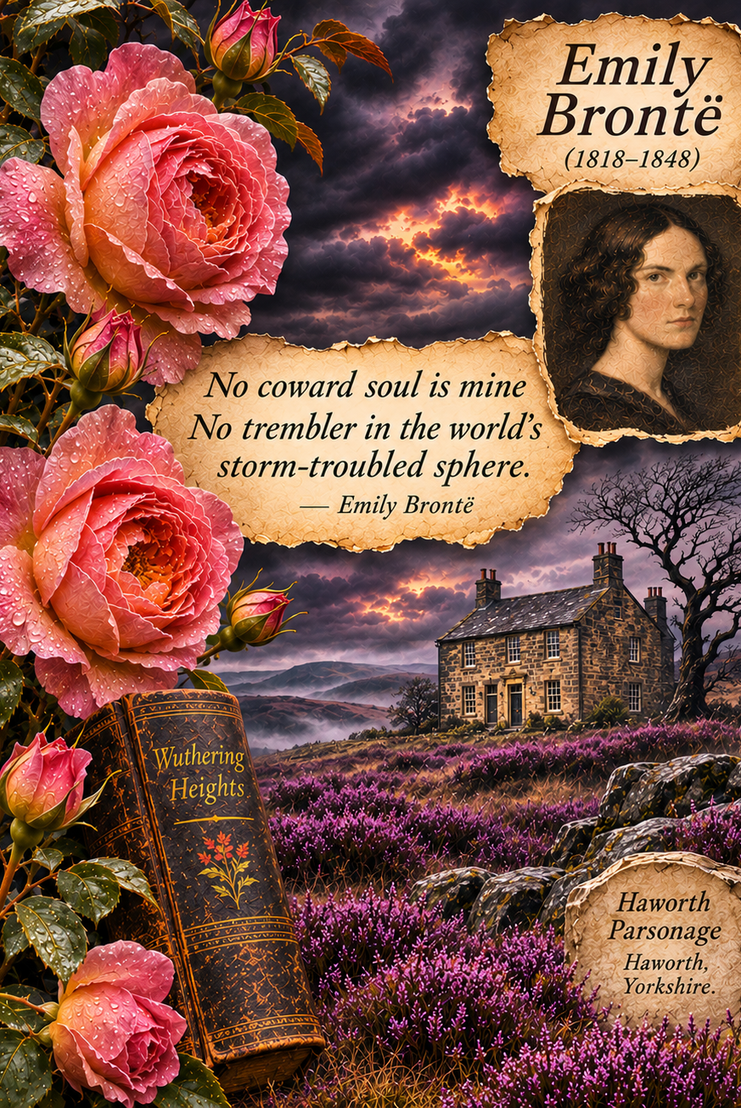
Rose Portrait
History & Heritage
Introduced in 2018 by David Austin Roses, ‘Emily Brontë’ (AUSearnshaw) is an English shrub rose named to celebrate the bicentenary of the birth of Emily Jane Brontë (1818–1848), one of the most distinctive voices in nineteenth-century English literature.
Its large, beautifully formed blossoms feature soft pink outer petals surrounding a warm apricot center. As the flowers mature, the petals gradually open to reveal a central button eye, a characteristic associated with many historic garden roses.
The David Austin English Rose Tradition
David Austin (1926–2018) devoted much of his life to developing roses that combined the beauty, fragrance, and flower forms of Old Garden Roses with the repeat-flowering characteristics of modern varieties.
Working from his nursery in Albrighton, Shropshire, Austin established a distinctive class of roses that became internationally celebrated for their romantic appearance and suitability for traditional English gardens.
Literature was a recurring source of inspiration for naming his roses. Shakespeare, Chaucer, Thomas Hardy, Charles Dickens, and the Brontë family are among the literary figures whose works and lives have inspired names within the David Austin collection.
The Brontë Bicentenary
Unlike many roses whose literary associations are inferred from their names, ‘Emily Brontë’ has a documented connection to the literary organization that preserves its namesake’s legacy.
The Brontë Society specifically approached David Austin Roses to name a variety commemorating the two-hundredth anniversary of Emily’s birth.
Founded in 1893, the Brontë Society is among the world’s oldest literary societies. It maintains the Brontë Parsonage Museum in Haworth, Yorkshire, preserving the family home, manuscripts, correspondence, personal belongings, and literary heritage of the Brontë family.
The rose’s registered denomination, ‘AUSearnshaw,’ also preserves a literary association through the surname of Catherine Earnshaw, the heroine of Wuthering Heights.
A Distinctive English Rose
‘Emily Brontë’ represents the culmination of decades of English rose breeding. Introduced during the final year of David Austin’s life, it embodies many of the qualities he sought throughout his career.
Its layered, relatively flat rosettes contain approximately 106 petals. The blossoms gradually soften from pink and apricot to cream, while their complex fragrance develops from Tea rose notes into a traditional Old Rose perfume, accented by lemon and grapefruit.
Its vigorous, upright growth and generous repeat flowering make it particularly suitable for mixed perennial borders and traditional English cottage gardens. David Austin Roses+2
A Living Literary Memorial
An intriguing contrast exists between the delicate appearance of ‘Emily Brontë’ and the uncompromising character of the woman it commemorates.
Emily’s literary imagination was shaped by the rugged Yorkshire landscape, its windswept moors, exposed stone outcrops, heather, and unpredictable weather. Her writing explored solitude, freedom, mortality, spiritual endurance, and nature’s untamed forces.
A rose bearing her name offers a living memorial rather than a stone monument. Its recurring blossoms celebrate a literary legacy that continues to flourish almost two centuries after her death.
For gardeners who love literature, ‘Emily Brontë’ offers a chance to unite two enduring English cultural traditions: the cultivation of roses and the celebration of the written word.
Literary & Cultural Influences
Emily Brontë: The Untamed Literary Imagination
Emily Jane Brontë (1818–1848) occupies a singular place in English literature. Although she lived only thirty years and published a single novel, her literary legacy extends far beyond Victorian fiction.
Writing under the pseudonym Ellis Bell, Emily explored the darker dimensions of human nature, the spiritual significance of the natural world, and the tensions between individual freedom and social constraint.
Her work draws upon the traditions of Romanticism and Gothic literature while resisting easy classification. The Yorkshire moors are not merely a setting for her writing but an elemental presence that reflects the passions, isolation, and spiritual independence of her characters.
Wuthering Heights (1847)
Published in 1847, Wuthering Heights challenged contemporary expectations of the novel through its unconventional narrative structure, morally complex characters, and refusal to sentimentalize love.
The relationship between Catherine Earnshaw and Heathcliff is inseparable from the wild landscape in which they grow up. The moors become a place of freedom, belonging, and escape from the restrictions of domestic and social life.
Catherine’s declaration to Nelly Dean expresses this profound identification:
My love for Heathcliff resembles the eternal rocks beneath: a source of little visible delight, but necessary.
Throughout the novel, Brontë contrasts the exposed, windswept landscape surrounding Wuthering Heights with the cultivated refinement of Thrushcross Grange. Nature becomes a language through which she examines class, identity, passion, violence, and mortality.
The registered name of the rose, ‘AUSearnshaw,’ adds another connection to Catherine and the fictional world Brontë created.
No Coward Soul Is Mine (1846)
Although Wuthering Heights remains Emily’s most celebrated work, her poetry offers an equally compelling expression of her literary and philosophical imagination.
In No Coward Soul Is Mine, written in January 1846, Brontë confronts mortality, religious orthodoxy, and the relationship between the individual soul and the infinite.
No coward soul is mine
No trembler in the world’s storm-troubled sphere
I see Heaven’s glories shine
And Faith shines equal arming me from Fear
Rather than accepting faith as a prescribed system of belief, Brontë expresses an intensely personal understanding of the divine as an eternal presence within existence itself. Her vision transcends institutional religion, locating spiritual certainty in the continuity of life and the universe.
The poem’s intellectual independence and spiritual defiance make it particularly appropriate for the Rosarium collage. The storm-darkened skies above the Yorkshire moors visually echo Brontë’s image of a troubled world confronted by an unyielding spirit.
Love and Friendship: The Wild Rose-Briar
Perhaps the most directly relevant poem for a literary rose garden is Brontë’s Love and Friendship, in which she contrasts the wild rose with the evergreen holly.
Love is like the wild rose-briar,
Friendship like the holly-tree—
The holly is dark when the rose-briar blooms
But which will bloom most constantly?
Brontë employs the seasonal characteristics of these two plants to explore the distinction between romantic passion and enduring friendship. The rose represents the intoxicating but potentially fleeting nature of romantic love, while the evergreen holly symbolizes constancy through hardship and the passage of time.
Unlike the traditional Romantic celebration of the rose as an emblem of love, Brontë questions its reliability as a symbol of devotion. Her familiarity with the natural world allows her to develop a metaphor grounded in the actual behavior of plants rather than conventional floral symbolism. The Poetry Foundation
There is a delightful horticultural irony in this association: the modern English rose named in her honor flowers repeatedly throughout the growing season, rather than offering the brief annual display of the wild rose-briar in her poem.
Remembrance: Time, Nature, and Mortality
In Remembrance, Brontë examines grief’s persistence against the recurring cycles of the natural world.
Cold in the earth—and fifteen wild Decembers,
From those brown hills, have melted into spring:
The changing seasons measure the passage of time, yet nature’s renewal does not necessarily bring emotional restoration. The landscape continues its seasonal transformations while the speaker struggles to reconcile enduring love with the necessity of continuing to live.
The poem resists the easy consolation often associated with spring. Instead, Brontë explores the difficult coexistence of memory, grief, and survival.
For the Rosarium, this poem introduces another dimension to the symbolism of the perennial garden: a place where renewal and remembrance coexist.
Gondal and the Literature of Imaginary Worlds
From childhood, Emily and her younger sister Anne developed an elaborate fictional world known as Gondal, an imaginary island kingdom populated by rulers, exiles, political rivals, and revolutionaries.
Although their prose narratives have not survived, numerous poems connected to Gondal reveal the complexity of this invented universe.
The influence of Sir Walter Scott’s historical fiction and Lord Byron’s Romantic imagination shows in its turbulent politics, isolated protagonists, dramatic landscapes, and moral conflicts. The Poetry Foundation
Gondal was more than a childhood amusement. It provided Emily with a creative environment in which she could explore power, freedom, loyalty, betrayal, and the consequences of human choices.
Her lifelong engagement with this imaginary world also places her within the broader literary tradition of world-building, demonstrating how invented landscapes can become vehicles for sophisticated philosophical and psychological exploration.
Romanticism and the Gothic Sublime
Although chronologically a Victorian writer, Emily Brontë shares important literary affinities with the English Romantics, particularly William Wordsworth, Samuel Taylor Coleridge, and Lord Byron.
Her treatment of nature, however, differs significantly from the restorative landscapes frequently encountered in Wordsworth’s poetry. In Brontë’s work, nature can be consoling, indifferent, liberating, or terrifying.
Her windswept landscapes also evoke the Gothic sublime, in which vastness, darkness, isolation, and elemental forces inspire both awe and apprehension.
This sensibility finds a visual counterpart in the paintings of Caspar David Friedrich and J. M. W. Turner:
Caspar David Friedrich (1774–1840). Works such as Wanderer above the Sea of Fog (c. 1818) and The Abbey in the Oakwood (1809–1810) explore solitude, mortality, spiritual contemplation, and humanity’s relationship with overwhelming natural landscapes.
J. M. W. Turner (1775–1851). His turbulent skies, atmospheric landscapes, and dramatic storm scenes reflect the Romantic fascination with nature’s elemental power.
Haworth and the Yorkshire Moors
The Brontë family moved to Haworth in 1820, when Emily was two. The parsonage became the center of the siblings’ domestic, intellectual, and imaginative lives.
Beyond the village lay the open Yorkshire moors, with their expanses of heather, exposed rock, solitary farmhouses, and seemingly endless horizons.
The ruined farmhouse known as Top Withens has long been associated with Wuthering Heights. Although it cannot be identified conclusively as the architectural model for the fictional house, its isolated position captures the atmosphere of Brontë’s novel. The Brontë Parsonage Museum+1
Today, the Brontë Parsonage Museum preserves the family’s material heritage, while the surrounding landscape remains an enduring part of Britain’s literary geography.
Brontë in Popular Culture
Emily Brontë’s influence extends beyond nineteenth-century literature into cinema, music, theater, and contemporary culture.
William Wyler’s 1939 film adaptation of Wuthering Heights, starring Merle Oberon and Laurence Olivier, helped establish the novel’s enduring association with Gothic romance in popular imagination.
In 1978, Kate Bush released Wuthering Heights, interpreting Catherine Earnshaw’s haunting presence through an extraordinary combination of music, theatrical performance, and Gothic imagery.
These reinterpretations demonstrate the remarkable adaptability of Brontë’s imagination across artistic forms and historical periods.
The Rose and the Landscape
There is something particularly compelling about the juxtaposition of the cultivated English rose and the untamed Yorkshire moors.
The softness of the rose’s pink and apricot petals contrasts with the landscape’s darkness, yet both possess an enduring beauty. The rose represents horticultural refinement, while the moors evoke solitude, freedom, and the sublime.
Together, they offer a visual interpretation of the contradictions that make Emily Brontë’s literary world so compelling: tenderness and ferocity, beauty and desolation, mortality and transcendence.
References
- David Austin Roses — Emily Brontë: Official Cultivar Description
- The Brontë Society and Brontë Parsonage Museum
- Canadian Food Inspection Agency — Plant Breeders’ Rights: Ausearnshaw
- Roses ABC — Emily Brontë: Cultivar History and Characteristics
- Rosewood Gardens — Emily Brontë
- Brontë, Emily. Wuthering Heights (1847). Project Gutenberg — Complete Text.
- Brontë, Emily. No Coward Soul Is Mine. Poetry Foundation.
- Brontë, Emily. Love and Friendship. Poetry Foundation.
- Brontë, Emily. Remembrance. Poetry Foundation.
- Poetry Foundation — Emily Brontë: Biography and Critical Analysis
- The Brontë Society and Brontë Parsonage Museum
- Brontë Parsonage Museum — Maps and Literary Walks
- University of Toronto — Representative Poetry Online: Emily Brontë
- Visit Bradford — Brontë Connections
- Hamburger Kunsthalle — Caspar David Friedrich
- Tate — Joseph Mallord William Turner
- Kate Bush — Official Website
Personal Impressions
Who doesn’t love Brontë? I think I first read Wuthering Heights before I could truly understand it. Re-reading it as an adult in literature classes changed my appreciation for it and deepened it, though I still think Heathcliff is an asshole and Catherine a cowardly racist. Still, the writing is amazing; the characters are so complex and wonderful, I find myself reaching for Wuthering Heights again and again. Emily Brontë’s poetry is also quite wonderful. Her rose reminds me of wild, windswept paintings, days when the wind almost knocks me off my feet and pushes me backward, an inner strength and resilience. It reminds me of the literature and poetry I love, and of my grandmother, who would have loved this rose in her garden for its color, hardiness, and scent.
Botanical Profile
| Characteristic | Description |
|---|---|
| Botanical Name | Rosa ‘Ausearnshaw’ (Emily Brontë) |
| Classification | English Shrub Rose, Modern Rose |
| Origin | England, David Austin, 2018 |
| Bloom Color | Soft pink with rich apricot centers, gradually fading to cream |
| Fragrance | Strong Tea and Old Rose fragrance with notes of lemon and grapefruit |
| Flowering Season | Repeat flowering from late spring through autumn |
| Foliage | Dark green, slightly glossy, with reddish-tinged young growth |
| Growth Habit | Vigorous, bushy, upright shrub, approximately 4 feet tall and 3½ feet wide |