
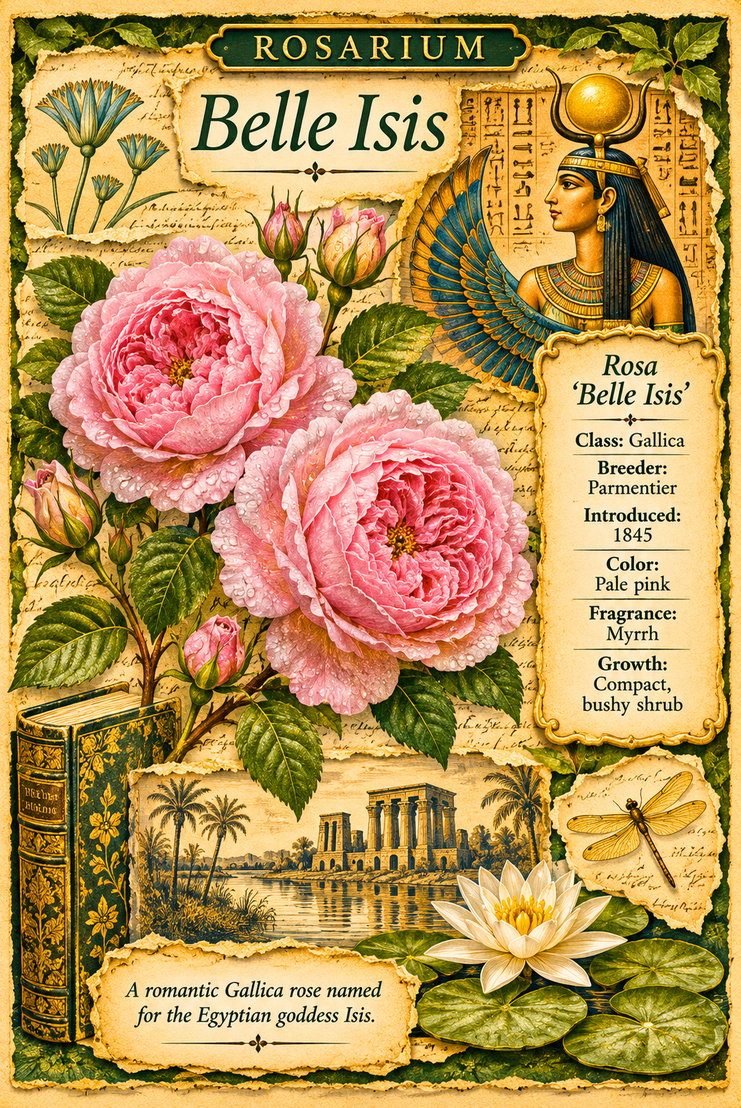
Rose Portrait
History & Heritage
Introduced in Belgium in 1845 by Louis-Joseph-Ghislain Parmentier, Belle Isis belongs to the Gallica family, one of the oldest groups of cultivated European roses. Its delicate blush-pink flowers distinguish it from the deeper crimson, purple, and magenta hues traditionally associated with Gallicas.
Although its own parentage remains unknown, Belle Isis occupies an important place in the history of modern rose breeding. David Austin crossed it with the floribunda ‘Dainty Maid’ to produce ‘Constance Spry’, introduced in 1961 as his first English rose.
Through this lineage, Belle Isis helped establish a new generation of roses that combined the romantic flower forms and fragrances of old garden roses with the characteristics of modern varieties. Its distinctive myrrh fragrance remains one of its most significant contributions to that heritage.
Literary & Cultural Influences
Isis: The Beautiful Goddess
The name Belle Isis means “Beautiful Isis,” evoking the ancient Egyptian goddess of motherhood, healing, protection, magic, and renewal.
In Egyptian mythology, Isis searches for the scattered remains of her beloved Osiris and restores him to life through her magical powers. Her devotion and perseverance made her an enduring symbol of love, restoration, and maternal protection.
Her influence extended far beyond Egypt. During the Hellenistic and Roman periods, her worship spread throughout the Mediterranean world, inspiring sculpture, literature, jewelry, and decorative arts. Egyptian Museum Cairo+1
The Golden Ass — Apuleius
In the second-century Roman novel The Metamorphoses, better known as The Golden Ass, Apuleius establishes a particularly beautiful literary connection between Isis and roses.
Lucius, transformed into a donkey by magic, is restored to human form through Isis’s intervention. During a procession honoring the goddess, he eats roses carried by a priest, reversing his transformation.
In this story, the rose becomes an instrument of transformation, liberation, and renewal — a particularly fitting association for Belle Isis.
Artistic Heritage
Representations of Isis in ancient Egyptian and classical art frequently depict her wearing a throne-shaped crown or a solar disk framed by cow horns. Delicate faience amulets, bronze sculptures, lotus flowers, and papyrus motifs evoke the artistic traditions associated with her name.
Personal Impressions
I first saw this rose back in 2006. I think I bought it at a nursery in Silverlake, but I could be mistaken. The bush I got was bare root, and the only hint I had was the name. My son Phillip’s daughter Isis had been born sometime before I found the rose, and so I snapped it up. I live in Silverlake, at 824 Maltman, in a bungalow court. My single bungalow had wall-to-ceiling French doors that opened onto a porch. I loved that little bungalow and the walk up and down that hill every day. I planted the rose in a terra cotta pot, and before long, I had leaves and buds. The rose thrived until I moved to El Sereno. I think it was lost somehow in the move, but honestly, I don’t think it would have liked that house. I wasn’t very happy there and ended up in San Diego for a time, then back to L.A., to Eagle Rock. In my future garden, I’ll try to find it again. My granddaughter is all grown up now, but I’m sure she’d like her rose blooming in whatever garden I have.
Botanical Profile
| Characteristic | Description |
|---|---|
| Botanical Name | Rosa ‘Belle Isis’ |
| Classification | Gallica; Old Garden Rose |
| Origin | Belgium, Parmentier, 1845 |
| Bloom Color | Pale blush pink with quartered, double petals |
| Fragrance | Distinctive myrrh fragrance |
| Flowering Season | Late spring to early summer; once flowering |
| Foliage | Grayish green |
| Growth Habit | Compact, bushy shrub |