
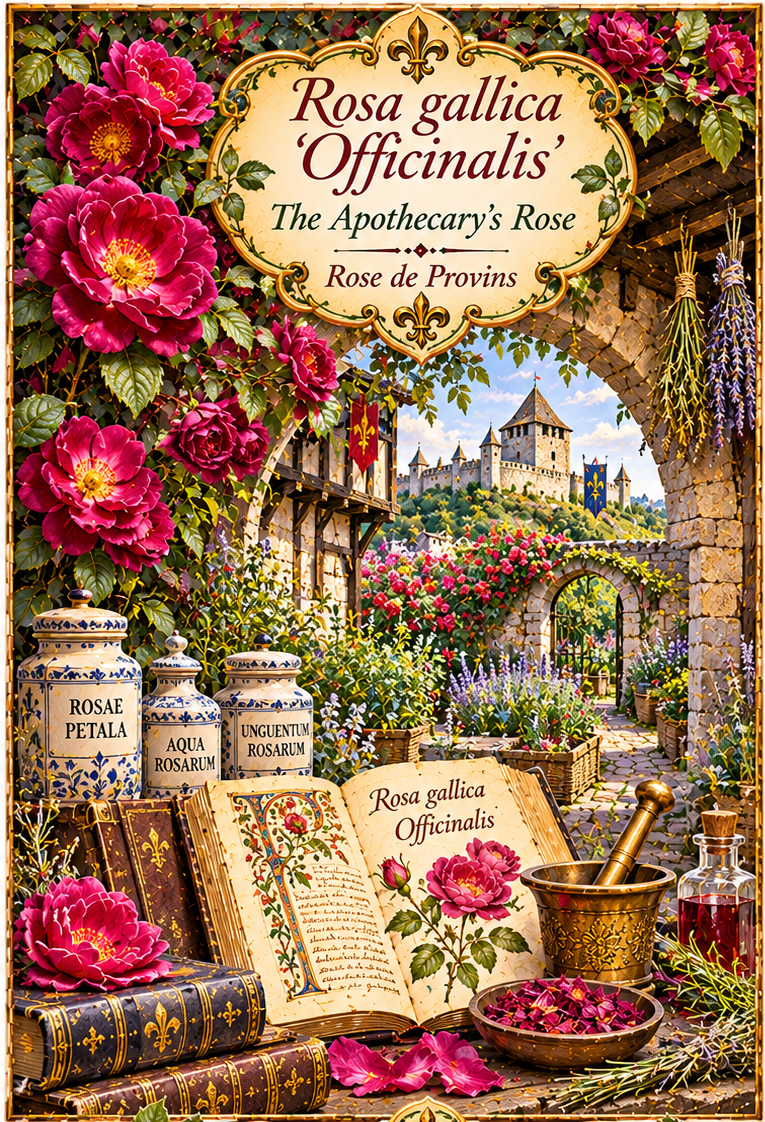
Rose Portrait
History & Heritage
The Apothecary’s Rose (Rosa gallica officinalis) is one of the oldest cultivated European garden roses. Its precise origins are lost to history, but its heritage extends back through centuries of medicinal, culinary, and ornamental cultivation.
Unlike many later roses bred primarily for their beauty, the Apothecary’s Rose was valued for its practical uses. People gathered and dried its fragrant crimson petals for medicinal preparations, rosewater, syrups, conserves, aromatic powders, and perfumes. It was a familiar plant in medieval medicinal gardens, where people cultivated flowers and herbs for their healing properties.
Its name, officinalis, reflects its historical association with medicinal preparations and the apothecary’s trade.
The Rose of Provins
The rose is also known as the Rose de Provins, after the medieval French town in the historic County of Champagne.
According to tradition, Thibaut IV, Count of Champagne and King of Navarre, brought the rose back from the Crusades around 1240. Thibaut was also a celebrated troubadour and poet, known as Thibaut le Chansonnier.
Although the story of its introduction remains a legend rather than established history, commercial rose cultivation in Provins dates back to at least the late thirteenth century. The town became renowned for its rose-based medicinal, cosmetic and culinary preparations.
The Red Rose of Lancaster
The Apothecary’s Rose is traditionally identified with the red rose of the House of Lancaster. Its heraldic association is believed to date to Edmund Crouchback, the second son of Henry III, through his 1275 marriage to Blanche of Artois, whose previous husband was Count of Champagne.
During the fifteenth-century Wars of the Roses, the red rose became associated with Lancaster, while the white rose represented York. After Henry VII married Elizabeth of York, the two colors were symbolically united in the Tudor Rose.
A botanical legacy
Around 1500, a naturally occurring mutation of the Apothecary’s Rose produced a rose with striped pink and crimson petals, known today as Rosa Mundi (Rosa gallica versicolor).
The Gallica family also contributed to the ancestry of several important classes of heritage roses, including the Albas, Damasks and Centifolias.
References:
- Historic Roses Group — Gallicas. Historical background and development of the Gallica family.
- Trees and Shrubs Online — Rosa gallica. Botanical history, cultivation and heritage.
- Uffizi Galleries — Rosa gallica officinalis. Historical cultivation and medicinal associations.
- Goodwin, George. Fatal Colours: Towton 1461—England’s Most Brutal Battle. London: Phoenix, 2011. Historical context for the Lancastrian and Yorkist rose emblems.
Literary & Cultural Connections
Shakespeare and the Temple Garden
In William Shakespeare’s Henry VI, Part I, Act II, Scene IV, the rival factions gather in the Temple Garden, where Richard Plantagenet and the Earl of Somerset invite their supporters to pluck white or red roses as declarations of allegiance.
Let him that is a true-born gentleman,
And stands upon the honour of his birth,
If he suppose that I have pleaded truth,
From off this brier pluck a white rose with me.
Somerset responds by calling upon his supporters to choose a red rose.
Although Shakespeare’s scene is a dramatic invention rather than a documented historical event, it remains one of literature’s most enduring representations of the dynastic conflict.
Together, the Apothecary’s Rose and Alba Maxima evoke this literary and historical tradition.
The herbal tradition
John Gerard’s The Herball, or Generall Historie of Plantes (1597) documents the importance of roses in Elizabethan medicine, cookery and perfumery.
Pierre Pomet’s Histoire générale des drogues (1694) also records the esteem in which apothecaries held the roses of Provins. Their reputation was such that they commanded higher prices than ordinary red roses cultivated around Paris.
The Apothecary’s Rose thus occupies an unusual intersection between botanical history, medieval medicine, culinary heritage, literature and political symbolism.
Literary references
- Shakespeare, William. Henry VI, Part I, Act II, Scene IV — The Temple Garden. Folger Shakespeare Library.
- Gerard, John. The Herball, or Generall Historie of Plantes. London, 1597.
- Pomet, Pierre. Histoire générale des drogues. Paris, 1694.
- Watson, John Dawson. The Two Roses. Nineteenth-century illustration of Shakespeare’s Temple Garden scene, Folger Shakespeare Library collection.
Historical qualification: Identifying the Apothecary’s Rose with Lancaster is traditional rather than conclusively documented. The specific connection to Edmund Crouchback should also be treated as tradition. I have verified the Shakespeare reference, but not the exact passages in Gerard and Pomet.
Personal impressions
As an armchair historian of the Hundred Years’ War, this rose captured both my attention and imagination as that series of wars triggered another: the Wars of the Roses, or the Cousins’ War, another period in history that has obsessed me. Finding a Shakespearean reference made me gleeful, and of course, I want it in my rosarium and eventual rose garden. I also think of the apothecary in Romeo and Juliet when I think of this rose. He’d have had its petals in his apothecary shop. I will plant it near Alba Maxima or maybe on opposite sides of the garden to symbolize the conflict.
Botanical Profile
| Characteristic | Description |
|---|---|
| Botanical Name | Rosa gallica ‘Officinalis’ |
| Classification | Gallica |
| Origin | Ancient European rose; cultivated in medieval France |
| Bloom Color | Rosy crimson with golden stamens |
| Fragrance | Strong, sweet old rose fragrance |
| Flowering Season | Late Spring to early summer; once blooming |
| Foliage | Dull gray-green |
| Growth Habit | Compact, bushy, upright shrub; spreads by suckers |