
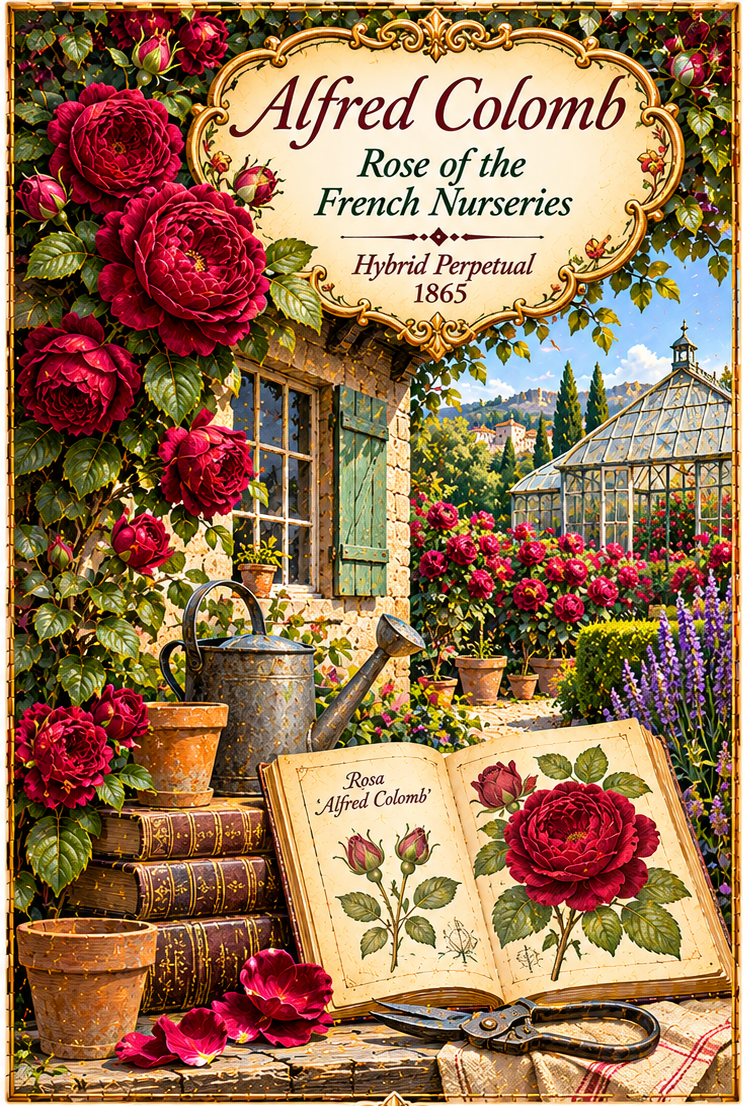
Rose Portrait
History & Heritage
Alfred Colomb belongs to the great tradition of nineteenth-century French roses. Introduced in 1865, it is a Hybrid Perpetual, a class of roses that dominated European gardens during much of the Victorian era, before the emergence of the Hybrid Tea.
Alfred Colomb was introduced during Napoleon III’s reign, when France led European rose breeding. Its breeder, François Lacharme, worked in Lyon, an important center of nineteenth-century French horticulture.
The rose was named in honor of Alfred Colomb, a Lyonnais rose enthusiast associated with the city’s horticultural community. Although his name survives through the rose, readily available sources provide little biographical information about him.
An illustrious lineage
Alfred Colomb was bred from Général Jacqueminot (1853) and an unidentified seedling.
Général Jacqueminot was itself a celebrated crimson rose named after Jean-François Jacqueminot, a French general who served during the Napoleonic Wars. It became an important ancestor of modern red roses, contributing both its rich coloring and distinctive fragrance.
Its fragrance also inspired François Coty’s celebrated perfume La Rose Jacqueminot, introduced around 1903 and instrumental in establishing the Coty perfume house.
A Victorian favorite
One particularly interesting historical reference appears in the 1883 article Old and New Roses, published in The Century. The author describes Alfred Colomb’s rounded flowers, fewer prickles, and greater tolerance of sunlight, recognizing it as the foundation of a valuable rose family.
Alfred Colomb continued to receive recognition well into the modern era, winning the American Rose Society’s Dowager Rose Queen award in 2000.
Its survival represents a living connection to the golden age of French rose breeding, when fragrance, abundant petals, and rich coloring were among the most prized characteristics of garden roses.
References:
- Old and New Roses (1883) — a contemporary Victorian account of Alfred Colomb.
- Museo delle Rose Antiche – Alfred Colomb — botanical characteristics and parentage.
- Roses ABC – Alfred Colomb — cultivar history and growing characteristics.
- Arnoldia, Harvard University’s Arnold Arboretum, 2015 — historical information about Général Jacqueminot and its connection to perfumery.
Literary & Cultural Connections
Alfred Colomb has no obvious connection to a particular literary work, historical dynasty, or legendary figure. Its cultural significance lies instead in the nineteenth-century French horticultural tradition and the Victorian fascination with roses.
The rose offers an opportunity to explore the relationship between gardening, literature, beauty, and collecting during the nineteenth century.
A rose in literature: Domesticities
There is, in fact, a particularly charming literary reference to Alfred Colomb in E. V. Lucas’s Domesticities: A Little Book of Household Impressions.
Lucas writes about reading rose catalogs in the depths of December as a way to recover the pleasures of June. He singles out Alfred Colomb, quoting its catalog description:
“Brilliant light scarlet crimson, large, full and globular, a magnificent rose of superb shape, very fragrant.”
He then poses a wonderful question:
“What must one do for one’s own name to be whispered to the coming ages by the breath of a rose?”
The man for whom Alfred Colomb was named has largely faded from public memory, yet his name survives in gardens more than a century and a half later. Wikimedia Commons
Gertrude Jekyll and the English garden
Alfred Colomb also appears in Gertrude Jekyll and Edward Mawley’s Roses for English Gardens (1902), where they include it among their selection of the finest roses then in cultivation. They praise its fragrance, vigorous growth, carmine coloring, and suitability for exhibition.
This establishes a direct connection between French rose breeding and the English garden design tradition.
The garden as cultural memory
There is something especially poignant about a rose that preserves the name of an otherwise largely forgotten person. Unlike monuments, portraits or written biographies, a heritage rose perpetuates memory through a living organism, renewed through cultivation and passed from gardener to gardener.
Alfred Colomb exemplifies the garden as a living archive. Its continued cultivation preserves not only a nineteenth-century horticultural achievement but also the memory of an individual, the breeder’s craftsmanship, and the aesthetic sensibilities of an earlier age.
Literary references
Old and New Roses — The Century (1883).
E. V. Lucas — Domesticities: A Little Book of Household Impressions, p. 72.
Gertrude Jekyll and Edward Mawley — Roses for English Gardens (1902), Chapter 23.
Personal impressions
I fell in love with the rich red color of this rose, and a little of its history as I perused rose catalogs, as I so often do. The color grabbed me first, and after learning it was an older rose, I looked into its history. Seeing the Victorian connection intrigued me further. It hearkens to exploration, colonization, collecting, my fascination with curiosity cabinets, and that age of collecting and documentation. I always hate the colonization and imperialism of the era, but remain fascinated by what motivated the collectors and that urge to name and document everything, to bring it home and grow it. I think of the garden I will eventually have, and maybe some of that collection fever resides in me, because I am doing that in this rosarium.
Botanical Profile
| Characteristic | Description |
|---|---|
| Botanical Name | Rosa ‘Alfred Colomb’ |
| Classification | Hybrid Perpetual (Hybride remontant) |
| Origin | France, François Lacharme, 1865 (derived from Général Jacqueminot) |
| Bloom Color | Rich crimson to carmine red |
| Fragrance | Strong, sweet old rose fragrance |
| Flowering Season | Late Spring to early summer; repeat blooming |
| Foliage | Dark Green |
| Growth Habit | Vigorous, upright shrub |