
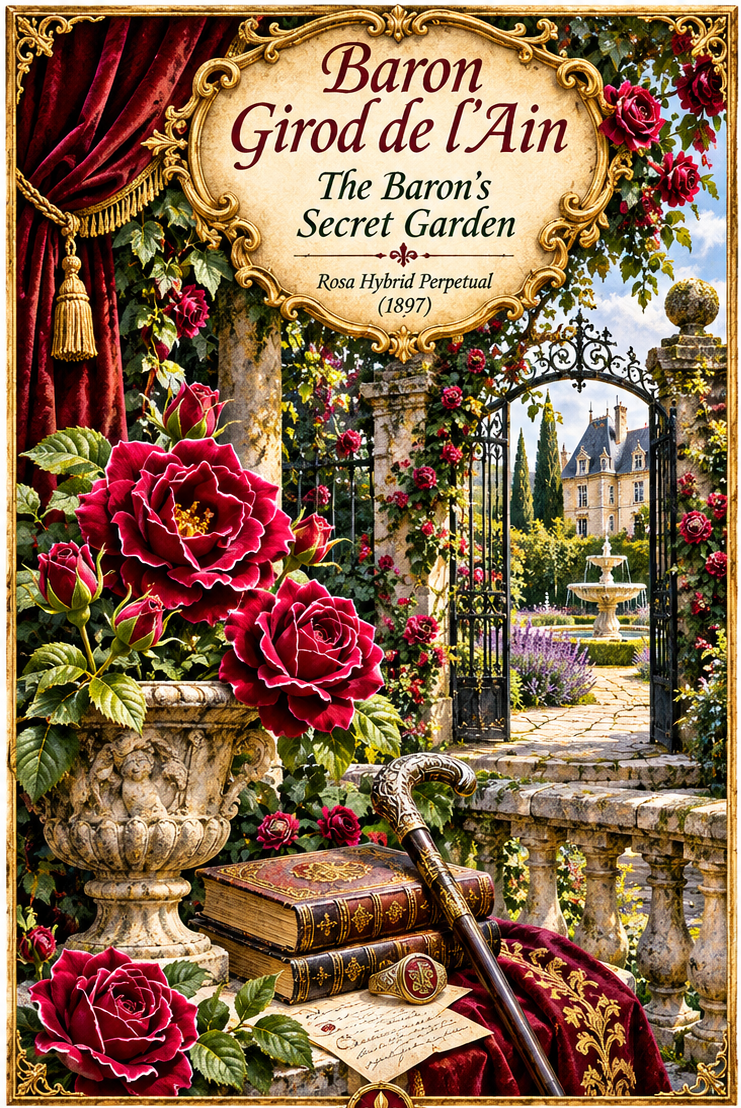
Rose Portrait
History & Heritage
Baron Girod de l’Ain is a French Hybrid Perpetual rose introduced in 1897. Its most distinctive feature is the delicate white edging along its deep crimson petals, an unusual trait that sets it apart from many other nineteenth-century heritage roses.
It belongs to the late Victorian period of rose breeding, when Hybrid Perpetuals were beginning to give way to the increasingly popular Hybrid Teas. Its rich fragrance, generous petals and remarkable coloring preserve the aesthetic qualities prized by nineteenth-century rose collectors.
A fortunate botanical accident
Baron Girod de l’Ain originated in Reverchon’s nursery in Lyon, France. Rather than being the result of deliberate crossbreeding, it emerged as a spontaneous mutation, known in horticulture as a sport, of the Hybrid Perpetual rose Eugène Fürst.
The mutation produced distinctive white margins along the petals, creating an appearance almost reminiscent of embroidered lace.
In July 1897, the Association Horticole Lyonnaise awarded the rose a large silver medal for its exceptional characteristics.
An account published in the March 1906 edition of the French horticultural periodical Journal des Roses describes its vigorous growth, large flowers, brilliant crimson coloring and distinctive white borders. Interestingly, the article records its commercial introduction as 1898, although most modern rose references give 1897 as its introduction date.
Who was Baron Girod de l’Ain?
The rose is generally believed to have been named in honor of Louis Gaspard Amédée Girod de l’Ain (1781–1847), a French magistrate and statesman whose career spanned several turbulent periods of French political history.
His positions included:
- President of the Chamber of Deputies
- Minister of Public Instruction
- Minister of Justice
- President of the Council of State
- Peer of France
The rose appeared in 1897, coinciding with the fiftieth anniversary of his death.
However, an alternative account attributed to rose historian Roger Mann suggests that the rose commemorates André Marie Édouard Baron Girod de l’Ain (1819–1906), a garden enthusiast from the Lyon region who may have discovered the mutation.
The identity of its namesake therefore remains open to historical inquiry.
A legacy of French horticulture
Baron Girod de l’Ain represents Lyon’s remarkable horticultural heritage, one of the principal centers of nineteenth-century French rose cultivation.
Its survival in modern gardens preserves an example of nature’s own experimentation, recognized and perpetuated through generations of gardeners’ skill.
References:
- Journal des Roses, March 1906. Historical description and illustration reproduced by Les Roses du Chemin.
- PharmaRosa — Baron Girod de l’Ain. Cultivar history, parentage and awards.
- Welt der Rosen — Baron Girod de l’Ain. Alternative account of the rose’s namesake.
Literary & Cultural Connections
The Illustrated Rose
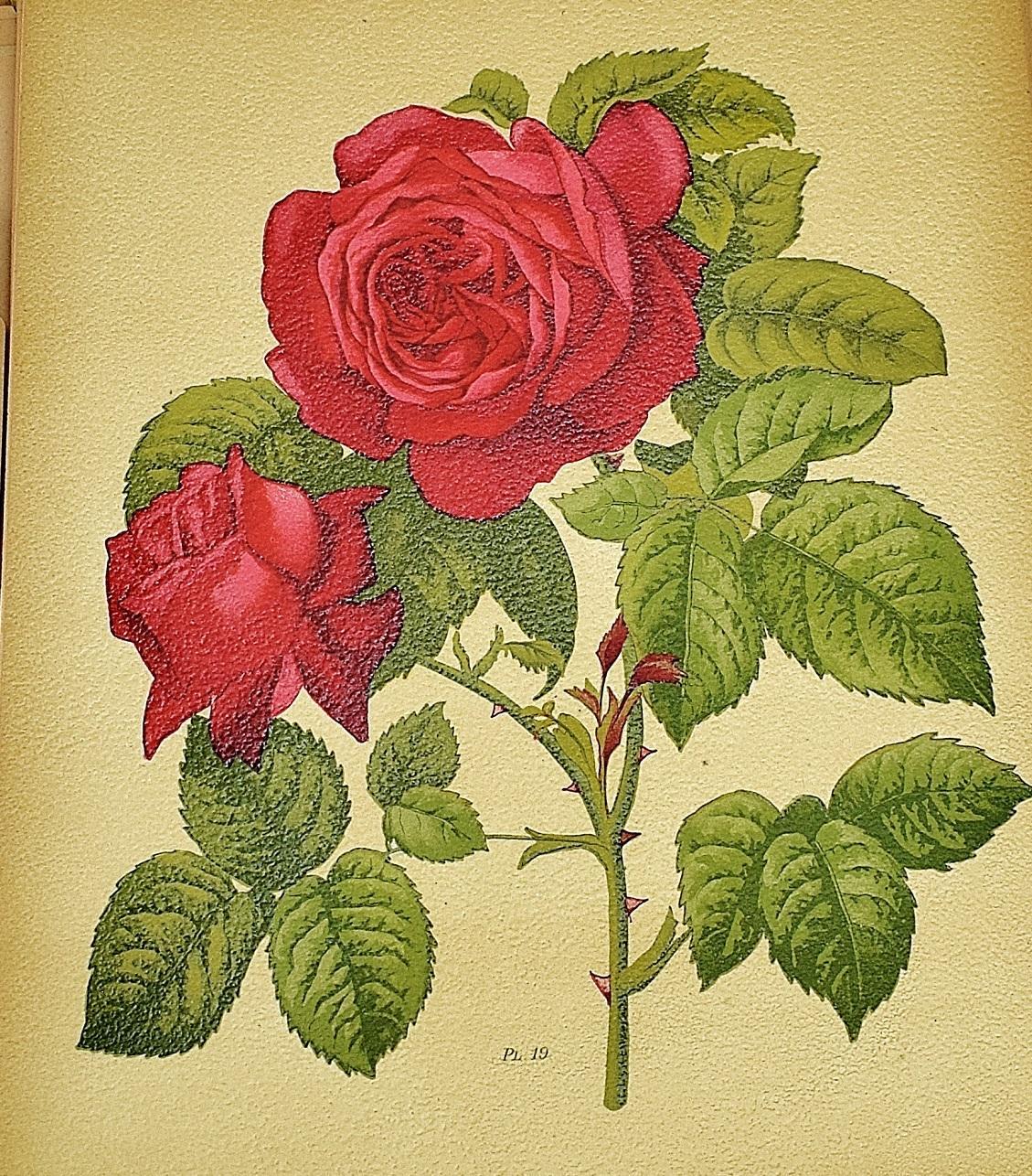
The Journal des Roses, a French horticultural periodical devoted to rose cultivation, provides an interesting cultural connection to Baron Girod de l’Ain.
Its 1906 account of the rose was accompanied by a color botanical illustration, reflecting an era when illustrated horticultural journals combined scientific observation, artistic representation, and the exchange of specialist knowledge.
These publications helped preserve the appearance and characteristics of cultivated roses long before color photography became commonplace. Today, they serve as valuable visual and historical archives of European garden culture.
Roses as living monuments
The nineteenth-century practice of naming roses after prominent individuals represents a distinctive form of cultural commemoration.
Rather than carving a name into marble or casting a likeness in bronze, rose breeders attached names to living plants that could be propagated and shared across generations.
Baron Girod de l’Ain is especially intriguing because the uncertainty surrounding its namesake illustrates how a plant can survive even as the historical memory of the person it commemorates becomes fragmented.
Literary & Cultural references
- Journal des Roses, March 1906 — reproduced by Les Roses du Chemin.
- Welt der Rosen — Baron Girod de l’Ain.
Personal impressions
I loved this rose for its color, its Lyonnaise origins, and its unusual white edges. I am drawn to the unusual and quirky, strong scents, and, of course, France. I also love a mystery, and the Baron the rose is named for could be one or the other. I am also very intrigued by hybrids and rose breeding. I wonder if, once I retire and have the time and space, I’ll try breeding roses, document my attempts, and write stories about living in a rose garden. It is a strong possibility.
Botanical Profile
| Characteristic | Description |
|---|---|
| Botanical Name | Rosa ‘Baron Girod de l’Ain’ |
| Classification | Hybrid Perpetual (Hybride remontant) |
| Origin | France, Reverchon, 1897 |
| Bloom Color | Deep crimson to carmine red with white-edged petals |
| Fragrance | Strong, sweet, fruity fragrance |
| Flowering Season | Early summer with repeat flowering in autumn |
| Foliage | Matte green |
| Growth Habit | Upright, vigorous, bushy shrub with prickly stems |